Guide to the FCHR Course
The First Coast Head Race comprises a 3-mile course along three connected waterways, winding through three bridges, skirting beautiful marshes, and passing through several riverfront communities. It is a test of strategic planning, solid decision-making, endurance, and grit for rowers and coxswains.
ANNOUNCEMENT FROM REGATTA DIRECTOR:
Read Letter Re: Course Adjustments Due to Weather - 6:15pm October 10th
COACHES MEETING at 6:15am: ALL available coaches, please meet tomorrow at 6:15 a.m. near the front entrance to the River House to discuss the changes and address any questions.
Just Added:
NEW! (Oct. 9th) - The 2025 Course FPV Guide Video has been posted. See Course Maps & Video section below.
NEW! (Oct. 1st) - Coxswains’ Navigation Guide pdf now posted for download. See Coxswains’ Guide section.
ANNOUNCEMENT FROM REGATTA DIRECTOR
Coaches,
I have spent much of the day adjusting alignment of the course buoys. Based on that experience, I am comfortable making the following statements:
The course itself is now in very good condition from the Start to the Finish.
However, the water conditions changed dramatically from the Start (unrowable) to the Finish (glassy calm). These conditions were experienced when a weather app said that the wind was out of the north at 13 mph. The different sections of the course broke down as follows:
From the Start Line Staging Area to the Mathews Bridge was unrowable, particularly for small boats.
On the Finish Line side of the Mathews Bridge, the water had some chop, but was rowable, particularly in going in the direction of the Finish Line with a tailwind.
When in the Arlington River and slightly away from the St Johns River, the water was good.
Before reaching the University Bridge to the Finish the water was glassy calm.
Tomorrow's forecast (by the same weather app) calls for the winds to continue from the north and range from 13-14 mph during the time of our races.
Based on the premise that we should conduct the races in safe, rowable conditions and that the course length can be as long as practical (within the maximum race limits), we are looking to be flexible in where the Start Line will be positioned tomorrow. As conditions change throughout the day, we may infrequently shorten or lengthen the course by moving the Start Line. The Start Line timing team will be located on a pontoon boat which can be moved as conditions may change. Masters age handicaps would be adjusted.
With the likely poor water near the original Start Line and potentially rough conditions at the Modified Bad Weather Start Line, the U15 and Middle School rowers will be impacted the most. If conditions after the lunch break are unfavorable on the majority of the original U15 and Middle School racecourse, we will move the Start Line for U15 and Middle School races to the far side of the Cesery Blvd Bridge (the side closest to the Finish Line). These races would then finish at the course's regular Finish Line. Those crews would pass through the Cesery Bridge on their way to their Start Line, but only at paddle pressure.
Given these potentially significant changes, we would like to conduct a meeting with ALL available coaches tomorrow at 6:15 am near the front entrance to the River House to discuss the changes and answer any questions.
Given the current king tides and the high likelihood of periodic rain (without lightning) throughout Saturday, all participants should dress accordingly, including water shoes for boats launching in the afternoon session.
On behalf of the FCHR LOC, we appreciate your willingness to work with us to negate the impact of any weather conditions that we encounter tomorrow.
Bob Schumacher
Regatta Director
First Coast Head Race
Course Maps & Video
NEW! 2025 Course FPV Guide Video
This video covers the final/installed course for 2025 from the coxswain’s view.
Map Detail: University Bridge to Cesery Bridge
Please refer to the marked lanes and spans on the map. This is not a bridge to approach at an angle, so for safety, line up early. The sharp inner turn requires more steering with rowers, so we recommend the outer lane and span for inexperienced eights and/or coxswains.
ALERT for MORNING RACERS: The spans of the Cesery Bridge will be backlit for a period of time after sunrise, possibly with intense reflections on the water if it’s a clear day. If you row during this time, focus on the buoy markers and surrounding features as aides to help you follow the course and straighten up early prior to homing in on your chosen span. Once you’re at a different angle to the sun, the backlight and reflections will become a non-issue — around the time you’re starting the last 1/3 of the turn and fine tuning your approach (another reason to line up early).
Google Earth 3d Course & Site Map
To help you get familiar with the course and site layout, we encourage you to explore the Google Earth map of the site and course, showing the venue, course buoy layout for port, starboard, and guide lanes, and also the designated bridge spans you’ll be able to travel through. To view in 3D mode, click the “3D” button, then the button next to it with the compass needle to open heading and tilt controls.
NOTE: There are NO “slides” set up — just use the map and controls to explore.
2. The Wide Bend / The Second 1500 meters
Competitors make a sweeping turn eastward into the Arlington River, entering the second-longest straightaway of the race, with the University Bridge standing prominently ahead.
3. The Turn Between University & Cesery Bridges
Once through the University Bridge, crews must quickly adjust their paths to line up EARLY for safe passage through the tight spans of the Cesery Bridge.
This turn is a test of skill for crews and coxswains (yet still quite manageable for novices with adequate preparation). An incorrect or careless approach risks crashes and damaged equipment. Take it seriously, both approaching AND going through the bridge arch. Shortly after exiting the University Bridge, you will see a string of small (9") guide buoys in the center of the race course. Choose a lane on either side of the guide buoys and follow the path, keeping your boat centered between the guide buoys and the outside course buoys. Following either of the two paths will position your boat to safely pass through the bridge arches.
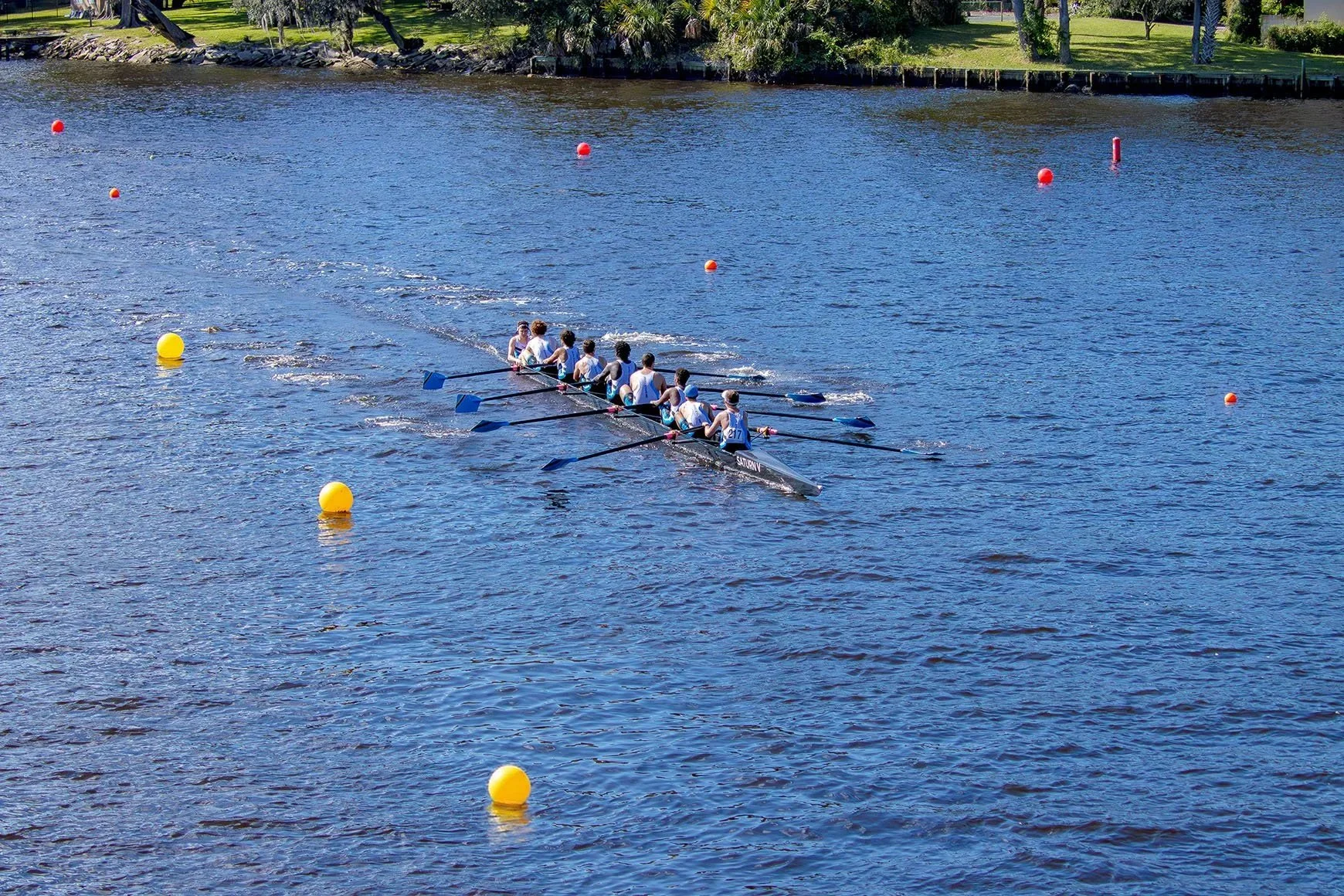
Crew rowing between University Bridge and Cesery Bridge, following the high-visibility course buoys and 9-inch orange guide buoys designating correct approach lanes for travel through the Cesery Bridge.
Photo of turn for reference only — no race buoys have been set up.
4. Center Stage at the Cesery Bridge
Approaching the Cesery Bridge, boats will be greeted by the crowd of cheering spectators on the shore and atop the bridge, reinvigorating their resolve for the final 1/3 of the course.
5. Navigating the Marshes
As boats leave the bridge crowds behind, they enter a waterway packed with graceful undulating turns, fewer straightaways, and shallower depths along the sheltered waters of scenic natural marshland.
6. 90-Degree Corner & Final Strokes to the Finish
This final challenge to maintain good steering through the end of the course culminates in a near 90-degree turn across from the Episcopal School of Jacksonville's boathouse.
Boats are now entering the final straightaway, sprinting to an exciting finish.
Shortened Courses
Should bad weather conditions occur in the St. Johns River (i.e., the start and first 1/3 of the full course), we will shorten the course for safety.
Bad Weather / Modified Course
If the regatta organizers make the decision to shorten the course for weather/safety reasons, the starting line will be moved to our Bad Weather / Modified Course chute approximately 1,250 meters west of the University Bridge, shortening the course by about one-third.
Short Course: Under 15 and Middle School
Under 15 and Middle School events will have the race shortened to exclude the Cesery Bridge passage, ending the race prior to the University Bridge.

